Showing posts with label "mexican". Show all posts

Sunday, May 8, 2011

Egg Tacos

Bumped into J.C. yesterday.  He made some tacos recently.  We discussed tacos and pulled weeds at fl'object.  Fl'object's propietor brought out three cans of beer.  We consumed the beer and pulled more weeds.  It was a pretty uneventful weed pulling session.  Not much to talk about, not even that much to look at, these are some egg tacos.  That day, I had little else that one could call food.


Admittedly, soft tortillas are probably better for egg tacos, but these sprouted-corn corn tortillas are just too healthy and too much like rabbit food to be eaten merely steamed.  On the other hand, they fry up great.  And rather than beat the eggs and then scramble them in the pan, I fried a couple eggs, over easy, and broke them up in a little bowl so that their yolks would spread around their whites like a sauce.  Then I plopped on some cheese.  Whoop-di-doo.  Stay tuned for a potentially more exciting post in the not-too-distant future.

Thursday, March 10, 2011

On Chili Powder and Home Economics

Yesterday wasn't the most productive day, though I did make pizza (not shown) and chili powder (shown).  Last summer my chili plants (various species) did really well, and last summer, unlike previous summers, I learned how to properly tie up a strand of ripe chilies for drying.  I used a heavy needle and heavy thread that I quadrupled.  Then I pushed the needle through the base of each stem, through the sepals.  


These are shown dry, but when I made this rope of chilies they were fresh.  I alternated the chilies, back and forth, for aesthetic value and to expedite the drying process: you want dry air to circulate around whatever it is that you hope to dry.  Hence, it's good to have some space around the individual chilies.  Then, once they were strung, I hung them in my pantry.


To make the chili powder I separated the seeds and stems from the dried flesh.  I did this by hand, breaking off the stem and knocking the seeds out.  I had another plate for the clean, seed free flesh.  As I did this, I wondered how commercial operations make chili powder.  I wondered how they separate the seeds from the flesh...


I sneezed a lot while grinding the chilies into powder.  That's a good sign.  That means that the oils are still potent.  Anyway, if I had a bigger mortar and pestle and a more refined technique, that is, if I could make more jars of chili powder per hour, I'd still be earning a pretty low wage.  I sometimes reach this conclusion when I make things from scratch at home.  I often wonder about the machines and cheap labor behind the various goods that are conveniently and cheaply and abundantly available to us.  The question then becomes, "why bother doing this at home?"  The answer must be found in the satisfaction of doing it AND in the superior quality of the product.  That said, if I combined the value of the fresh produce and the value-added goods I made from the fresh produce I took from my garden this year (tomato sauce, dried chilies, chili powder, jams, pickles, etc), I think this year I came out on top for the first time, money-wise, if only by an inconsequental hundred bucks.    

Monday, December 6, 2010

Taco Shells

Readers have been complaining about infrequent updates.  They want to know what is going on.  Why am I not updating OilChanges more frequently?  "What on Earth" they ask, "have you been doing with your time?"  Well, it's like this: I moved into this new office recently and I've been leaving my camera up here.  I make some food, sit down to eat, look for my camera, and realize that there are two flights of stairs between me and it, and so I say, "Fuck that.  I'm not climbing a bunch of stairs just to take a snapshot of some tacos."  So here are some tacos I made this summer.  Tacos that I think I already posted about.  In compensation for that, some pointers on frying your own corn tortillas will follow the picture.


Clearly, those taco shells are brilliant.  And you can do it, too!  Seriously, you can.  You too can make taco shells, tostadas, and chips.  There is nothing like the smell of a good corn tortilla that is getting crispy in some hot ass oil.  Seriously, it rules.  So here are some pointers:

1) start with the best damn corn tortillas that you can find: I think that coarsely ground, maybe stone ground yellow corn tortillas—not white corn—are the best for frying.  You get a harder, crunchier result with yellow corn tortillas.  To know if you have found the right ones, simply use your eyes: does the "grain" look smooth or somewhat rough?  If you can easily roll a room temperature tortilla into a tube without that tortilla cracking, spend some time looking for tortillas that will break if you attempt to tube them.  

2) get yourself a pot or a big deep cast iron skillet: you want a vessel that will retain heat.  Hot temperatures are essential to good frying.  If you are making tostadas, you can use a fairly shallow pan, but for chips you want something deep.  I use a 2.5 quart stainless steel pot with a heavy-duty bottom.  Now about oil...

3) the darker the oil, the lower the smoke point.  The smoke point is the point at which the solids, i.e. those things in the oil that burn, well, burn.  Dark oils like sesame oil are totally unsuitable for frying.  They will never reach a temperature that is hot enough to get a good result.  Same is pretty much true for most olive oils—don't use them.  I heard about a recipe for french fries fryed in olive oil and I politely said, "hmm, yeah, maybe," but I really meant, FUKCING STUPID.  Basically, buy Canola or vegetable oil by the gallon and use that.  Then, crank up your heat to pretty much full flame.  If your chips or shells are burning before getting crispy, uh, turn that shit down a notch.  Not rocket science, folks.  

4) reusing your oil: oil is good for many sessions of frying, like 20.  I keep a five gallon bucket in the garage for discarding wasted oil.  One day I plan on giving it to someone who has a vegetable oil powered car.  Anyway, when you are done frying, leave the pan or the pot on the stove until the oil has cooled.  Then, do like I do: pour it into a big jar and save it for the next purpose.  Or, get a pot that is only for frying and leave the oil in that pot.  You don't even need to cover it.  Just shove the pot into an out-of-the-way place and forget about it until you need it again.  Oil does not spoil.  No spoil oil.  

Peace, and look forward to some more posting soon.  Oh, and if you are making chips, hit them with some salt right after they come out of the oil.  Tools needed: slotted spoon, forks for making taco shells.  You need two forks; tongs will work, too.  Come back another time for the technique, or simply go on youtube and watch some demos.  Later.

Saturday, November 6, 2010

breakfast tostada

Made these breakfast tostadas yesterday.  Delicious.  Fuck!  Excuse me for a moment...take this time to think about the things you will do wrong today: use a shovel instead of a rake to move wet leaves; drive a car with a cup of coffee on the hood; make a tent out of propane: I am back.  Had to run inside and take care of some business.  Right.  My thoughts about variations on Mexican themes: I used to be anti-fusion, still am, really, hate the fusion movement in cooking because, honestly, the dishes usually end up being violations against good taste.  Not that the food tastes bad, but really, what's the point of stuffing Korean BBQ into a four tortilla?  Or Mexican ravioli?  Just satisfy yourself with making a good tamale.   Just eat your BBQ and get on with it.


Really, I shouldn't be against fusion.  I mean, I understand how the world of food goes round and round.  Cultures share, steal, dominate, push their agendas onto other cultures, trade, borrow, and so forth, and food changes with time.  We eat whatever foods are available, and our diets are a consequence of our situation, our station, our location in time and on the planet.  Still, this fusion movement reminds me of someone who has read Darwin, but someone who has misunderstood evolution.  Foods and food cultures change as they will, not as we will them to.  Some fusion chefs just push too hard.  The audiences love it.  Some people want to ram Tibetan foods into pierogi.  Tibetan pierogi.  Whatever.

  
If break these breakfast tostadas down into their component parts, it becomes pretty obvious that I have not reinvented the tostada; in fact, this is a pretty traditional tostada, whatever that means: deep fried, stone-ground yellow corn tortilla (CRUNCH!), mashed up beans (with lots of added fat; I used butter, not traditional lard), cheese, scrambled egg (wanted runny yolks, fucked up), and sauteed KALE.  It's really only the kale that pushes this recipe into a somewhat new-ish terrain.  I don't know how big Mexicans are on kale.  Not that big, I imagine.  Small on kale.   

Wednesday, April 28, 2010

Lentil Enchiladas, Lentil Tostadas

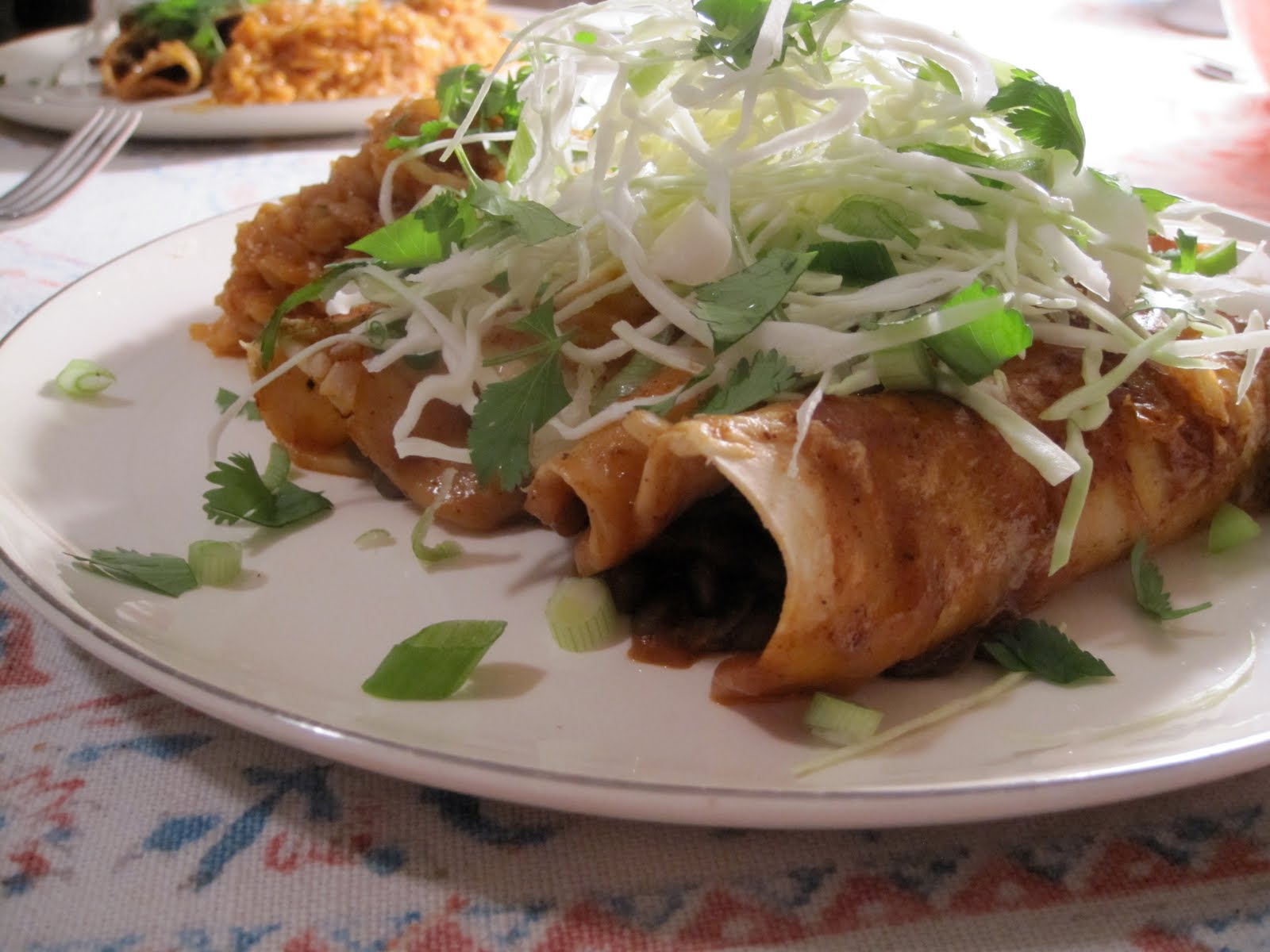
I just googled, "Do they eat lentils in Mexico?"  and it turns out that, yes, people who live in Mexico do eat lentils.  Why?  Because there are lentils in Mexico.  Why else?  Because lentils are cheap and delicious and many Mexicans are poor.  Therefore, one could extrapolate and logically deduce that Mexican Restaurants in America, especially the more authentic ones, would serve up various lentil foodstuffs.  But of course, they don't.  They serve ground beef.  Why?  Because they aren't that authentic after all.  Anyhoo, I'm not sure if these lentil enchiladas (and these lentil tostadas) are authentic either, but I am sure that they are outrageously delicious.  You can ogle these pics if you don't believe me.


The sharp ogler will observe some finely shredded cabbage.  Cabbage!  What?  On Mexican food?  Well, I don't mean to be totally outrageous here, but finely shredded cabbage is a superb replacement for shredded Iceberg lettuce.  It's got better crunch, better flavor, and better nutritive value, and they might even eat members of the cabbage family in Mexico, just maybe.  But do you ever see shredded cabbage at authentic Mexican Restaurants?  Nope!  You see it under your egg roll at Chinese restaurants, and you see it by the truck load around Saint Patty's Day, but nope, it's all Iceberg Iceberg Iceberg at Chi-Chi's and Chilies, La Torre, El Toro, El Dopo, La Migra, and Los Alamos!   Why?  Why no cabbage either?  Take a wild guess, Einstein.


Did you notice the Spanish Rice in the background?  You didn't?  That's because it's not Spanish.  You should know this by now.  But if you don't, I'll repeat: THE RICE IN THE BACKGROUND IS NOT SPANISH!!!  

fresh out of the oven

And now onto the lentil tostadas...


With the tostadas I did something completely wrong: I sliced up some Snow Peas and added them to the salad topping.  "Snow peas?" you say, disparagingly.  "There is no snow in Mexico.  I just googled it.  There isn't snow until at least the highlands of Peru, and even then there aren't any peas!"  Well, guess what people?  It's like the story my grandmother told about the Swedish Man who ran the pizza shop in New Jersey.  When asked what business a Swede had making pizza, which is an Italian food, he replied, "Cooking is International!"  And so it is.  But I still cannot understand why these Authentic Mexican Restaurants don't serve more lentils!   
     

Sunday, April 11, 2010

corn tortillas, Paul's Recipe

Maybe a couple years ago, Paul moved to Los Angeles.  Maybe a couple days ago he sent me the following email:

"I never buy pre-made corn tortillas anymore..."

with the following picture attached:


I responded thusly:

"tell me how you make them.  I'm making bread again, pain de mie"

Then Paul sent me his recipe:

ok.. well. i use the instant corn masa flour, so get a 4 pound bag. you need a lot for practice.  i am using the rick bayless recipe as a loose base for what mine developed into over the last 2 months.  
1. pour like 2 cups of the masa flour into a bowl with a big pinch of salt.
2. add water until you get the consistency of icebox cookie dough or sugar cookie dough.  too dry or wet? the shit is easy to fix.  you'll know jono, you'll just know what's right here.
3. roll into balls no bigger than a smaller golfball
4. take your thickest sandwich bag and cut the sides so it opens like a book. cut off the ziplock too.
5. put a ball of dough between the sheets of plastic and roll with a pin until even thickness which is important.  they can be thick or thin, as long as they are consistent.  you'll find your size.. mine are slightly thicker than traditional store specs.
6. oops! meanwhile you should have 2 dry cast iron pans on the stove. one at low heat and one at the white hottest.
7. peel the top layer of plastic off the tortilla and turn it over placing the tortilla side on the palm of your hand with about an inch of the tortilla "hanging over".
8. peel off the top plastic and "lay" the tortilla into  the cooler pan. 20 seconds or so on each side to "set" the tortilla. burn your hands.
9. now the fun part. 30 seconds on each side in the hot as hell pan, maybe 40 if you want more burnt character.  if you did everything just right, the tortilla will soufle!  i've had them blow up like a football..
10. i make a batch and then fry them in a little canola before eating.. 
11. buying a tortilla press would make this a whole fucking lot easier and i don't know why i haven't since they're all over the place out here. 
 good luck! if you get into this- you will make some beautiful tortillas. -paul

Thanks, Paul.  


Sunday, January 31, 2010

"Nachos Here, Get Yer Nachos Here"

I've been thinking about nachos all week.  Actually, perhaps "thinking about nachos" isn't exactly right.  More accurately, I've been "hankering after nachos" since last Sunday.  What is about Sunday that puts nachos into the mind?  Football?  God?  Perhaps there is no connection between nachos and Sundays.  Perhaps there is also no connection between nachos and sauteed, shredded kale.  That is, there was no connection until I did it.  I put some kale on some nachos, and the world shook, just a little bit it shook.

 
The beautiful thing about these "healthy" nachos---actually, screw the quotes---is that while they are indeed healthy nachos, they still taste like stadium nachos, like nachos from a gas station whose cheese comes from a pump, thanks in large part to the pickled jalapenos.  But let's get back to this healthy business. 

I started by deep frying some really nice corn tortillas.  When I was visualizing these nachos, I didn't see the typical nachos with their melted cheese and their burnt chip edges.  I saw nachos with cheese sauce, pickled jalapenos, and shredded lettuce.  Ah, but shredded lettuce is so predictable!  So forget shredded lettuce, I thought to myself.  Kale!  I will saute shredded kale and garnish my nachos with it.  It will make the junk food lovers roll over in their graves!  And I'll add some spicy beans, too.  But they won't be black beans because, again, black beans on nachos is too predictable.  Let them be kidney beans!  And let me cook them with some sauteed onion and crushed chili, and let me simmer them in beef stock. 


 As you can see, like the great pyramids of Egypt, I built these nachos in tiers.  One of the problems with inferior nachos, such as you can find in places like Buffalo Wild Wings, or pretty much anywhere else in this blasted sports-bar world, is that the cooks don't bother to properly build the nacho pile.  They just chuck stuff onto chips and call the pile nachos.  Strictly forbidden.  My healthy nachos would not be chucked together.  Like the Louvre in Paris and the Arc de Triomphe (also in Paris), these nachos would be built, and built to impress.  It has been said, that when a duke lays eyes upon a poorly built pyramid of nachos, he imposes a mandatory punishment on all the denizens of his dukedom---that is, he cuts of everyone's hands.  Not that pleasant.

This is a single, kale nacho (to emphasize the cheese sauce):

To make the cheese sauce, you must first learn to make bechamel.  To make bechamel, you do this:

Cook an equal part of flour in some oil (or oil and butter combined); when the flour is fully cooked, it will either be "blonde" or "brunette."  (I prefer brunettes.)  Once this happens, add some milk and bring the milk just to a boil.  Then, turn down the heat and slowly add your shredded cheese(s).  You might also want to add some paprika.  Finally, keep doing this until you've got a cheese sauce that's cheese sauce consistency.  And that's pretty much it.  Now, go forth all of you, and build some nachos. 

Tuesday, January 19, 2010

The Best Chili Ever

Chili is so contentious. Or rather, people get so contentious about chili. You either make the best chili or you know where to get the best chili. Therefore, it logically follows that, by the definition of "the best," everyone who either (a) claims to make the best chili or (b) names some other place or person as the source of the best chili is, by logical necessity, DEAD WRONG because I make the best chili. I will explain why.


That is not the best photograph of the best chili, but it will serve our purpose. Our purpose is for you, the reader, to learn how to make your own version of the best chili ever.

To start, you absolutely must make a very good beef stock. I use oxtail bones, and I make sure to select pieces of oxtail that have a huge amount of pure, white fat around the bone part. I trim this fat, put it into a sauce pot, and melt it in "a low oven," i.e. at 200 degrees or lower. This is called "rendering the fat." By rendering the fat you turn it into a usable cooking fat. First, the fat melts, then it cools and solidifies, and finally, it goes back into the bottom of your chili pot (we'll get to that part later). Meanwhile, back to the oxtail bones.

Make a stock with your oxtail bones and your mire poix (2 parts onion, 1 part celery, 1 part carrot). When the stock is fully cooked, strain out the mushy vegetables, pull out the bones and reserve them for later. At this point your stock will probably be a light color, like the color of a lager, and since you'll be wanting to make the best chili ever, you should reduce your stock until it is much darker, not as dark as a stout, but more like the color of a good ale. (This process, including the fat rendering, will make your kitchen smell outrageously awesome.)

bernard clayton's Complete Book of Soups and Stews (some good chili talk here)

So, now that you've got your rendered, chilled fat and your heavily reduced oxtail stock, the next thing you'll be wanting to do is this: get your chili ingredients in place:

ingredients for the best chili ever:

killer oxtail stock and rendered fat
a good pile of kidney beans, cooked to perfection*

*note* you must start with dry beans; canned beans have inferior texture and flavor; see my post, Beans, beans, beans for help with that

a 15 oz can of whole peeled tomatoes
a medium onion and some garlic
assorted, dried chilies (dried chipotles are really nice)
spices & herbs (cumin and/or toasted cumin, maybe some crushed coriander, chili powder as necessary, dried oregano, bay leaf)

optional: red wine or beer

***YOU WILL NOTICE THAT THERE IS NO ACTUAL MEAT IN THE BEST CHILI EVER, ONLY AWESOME MEAT FLAVOR***

And this is how you do it:

Put your rendered fat into the bottom of your pot (along with some olive oil if you didn't get a good quantity of fat) and heat your pot to something like medium heat. Toss in your diced onions and cook them until they get some nice color. (Here, burning them a bit is not a problem; in fact, it will lend some smoke to the flavor.) Then add your dried herbs and spices until they become aromatic. (Cooking dried spices in oil or fat helps to release and spread their flavors.) Then add your garlic until it becomes aromatic, about 30 seconds. Then, bang in your can of whole peeled tomatoes---oh, be sure to get good tomatoes---deglaze the pot as necessary, bring to a boil, toss in your various dried chilies + bay leaf, reduce and simmer. (Your tomatoes will break apart own their own, but you can help that process along with a fork.)

At this point you will have a dark, thick, spicy tomato broth. Keep this cooking until all the flavors have developed and melded. Then add some of your dark oxtail stock. This will produce a less dark, less thick, spicy, beefy tomato broth, and that's the foundation for an awesome chili.

OK, let's say that you've got your foundation to the exact color, thickness and flavor that you desire. The next thing you'll want to do is add your beans. Here, I cannot overemphasize how important it is to use a ton of beans. You want this chili to be 70% beans. (Hence, the importance of really nice beans). Right. Now you can go ahead and dump in your beans AND some of that gorgeous and flavorful, dark and ruddy bean cooking water. Once this is done, simmer the pot for a bit, salt and pepper gradually to taste, and then simmer a bit longer.

If you have done everything right, you should have some really nice chili.

Monday, November 2, 2009

burrito baby, the movie

The question has been posed...

If you throw your burrito into the air, does it get fuller?

Guest starring the Don, watch "Burrito Baby" and find out!


************************************************
obligatory traffic generating language:

How to roll a burrito, fold in the corners and stuff, Don Corleone eats burrito!

Hip hip hoooray!

************************************************

Monday, September 14, 2009

Lentil Throw Down

According to some schmoe, there are two kinds of cooking, the cooking you do for yourself, and the cooking you do to impress other people. This same schmoe asked me which I prefer. He was flabbergasted when I told him I prefer home cooking. So, for him and for all of you, the rebirth of OilChanges, a brand new video!


Tuesday, April 21, 2009

lentil tostadas

A quick post before I dash into the rain...

More and more lentils...

The rain is wonderful today.


Friday, March 20, 2009

Taco Spree

My spring break is just about gone and so is my pink eye. It's been a boring but peaceful week and I accomplished zilch. Well, almost zilch. I suppose healing is a kind of accomplishment. In one hour I have an appointment with the eye doctor, the optometrist, and so it's been my goal since Monday morning to get my eyes well enough to be examined for some long-awaited, long overdue, new glasses! Hooray! These ones are entirely scratched, bent, missing one nose pad, etc etc. But what does this have to do with tacos and taco sprees? Well, nothing exactly.

Wednesday night, to alleviate some boredom and loneliness (too much youtube syndrome), I took myself out on a cheap date to Veracruzano, Northampton's pathetic excuse for a taco joint. Let's just say that I was not at all pleased with dinner, and thus I took it upon myself to make some decent tacos, pictured here. Thursday's lunch, fish tacos (below); Friday's lunch, bean tacos (above). The trick is in the shell. I found some outstanding, rough, corn tortillas at the River Valley Market and fried them into the crunchy, crackling glories you see here.


And that's it. Tacos have nothing to do with eyes, except this: I can't write about tacos anymore because I need to get my eyes checked. I promise you, you will never hear that sentence ever again, so long as you shall inhabit this verily green, fiesta-ridden, plush Earth. Bye bye pink eye! Hello new specs! Adios los tacos! Hola contact lenses. Fishy beany goodness with a crackle and a smile, let spring set upon us like a fat, green glove. Like the wind, Veracruzano blows. Peace.

Saturday, September 27, 2008

Bean tostadas, miserable bachelor?

Miserable? No, not really, but if my loyal readers have noticed a definite shift towards some miserably unapologetic low-brow fare, it is not because I tossed my copy of "Mastering the Art of French Cooking" into Puffers Pond, but because I have returned to that other shallow but pleasingly lukewarm body of water known as bachelorhood. There's just no reason to spend entire afternoons hand-crafting ravioli. Nope, I would just end up freezing them for some murky future, or pitching them one-by-one onto the street, like little bits of flesh torn from the big, doughy heart of love. There are better and quicker ways to love the self.

Exhibit A: bean tostadas with all the fixin's. Now, in case you consider me flip, there is sense behind this post. There is a reason why bean tostadas follow bacon sarnie. It is not purely alphabetical. It's more to do with bacon fat.

The trick to refried beans is fat. Traditionally, refriend beans are made with lard! Whatever fat you choose, choose a fat. Fat gives the beans their velvety smooth succour. You can use canned or homemade beans, and you can season them however you wish; you can even use whatever kind of bean you desire. It doesn't really matter. These refried beans started out as dry red, black, and pinto beans. Whatever you do, here's the idea:

Ingredients:
bacon fat, or some other fat (a combination of butter and olive oil works just fine)
beans
onion, garlic, spices (cumin, chili flakes, chili powder, black pepper)

Directions:
Cook some chopped onion in the bacon fat and cook on medium or low heat.
Add the minced garlic (a clove or two), and the flakes, and cook about 30 seconds
Add some of the spices and dump in the beans;

If your beans are home cooked, include the cooking water. If not, go ahead an use that thick canned bean goo if you choose. Otherwise, add some water. In any case, you want your mixture to be liquidy.

Bring it to a boil and simmer on low heat until the beans are nearly dry. You can continue to add seasoning as it cooks down if that's your pleasure.

Once your beans have simmered down, get yourself a heavy duty smashing instrument (I use a heavy duty fork), and start smashing the hell out of them.

Sample your smashed beans. If they are not silky smooth, toss in a wad of butter and continue mashing them.

That's pretty much it. Season them with some salt to taste, and pile them on a tostada. If you want to be a hardcore bachelor, get yourself a wooden spoon and bring the pot to bed with you. Shove spoonfuls of refriend beans into your mouth as you read a men's interest magazine. Or don't. It just depends on your preference. Mine is to maintain a shred of dignity, hence the shredded lettuce; it adds a touch of class.


Friday, August 15, 2008

Summertime Chili

Before you get all bent out of shape and ask, "Chili in the summertime? Isn't chili a winter dish," I am here to explain a little something. In my kitchen, there is summer chili, and there is winter chili, and the difference is in the chilies themselves. It is summer chili season, and oh what a season it is. Actually, it's been ridiculously rainy. The grass isn't even brown! Nonetheless, we continue.

Summer chili uses the fresh, ripe chilies that become available up here in the north, in August. Winter chili uses the same chilies, but in their dried, crushed, whole, or powdered forms. Chiles as spice (winter) rather than chilies as vegetables (summer). In either case, you get a "rounder" or "fuller" chili flavor if you put several varieties of chilies in your pot, sweet and hot. I keep no prescribed formulas but this: play around but use good technique.

And here's my current technique: