I had to prematurely pull some shallots today to make room for the winter squash starts I will plant in a couple days. I planted the shallots in a rush last fall—in a rush and in the ground—and I wasn't thinking about the future when I did so. Or perhaps I was thinking about the future—I don't remember. I did plant the shallots in an out-of-the-way spot on the edge of the garden, but the spot was not out-of-the-way enough, and so today I pulled some of the shallots up. Some of them are still in the ground. It doesn't matter. What really matters when you are happy? I puttered around in the garden. I pulled some shit early. "And then He Kissed Me" by the Crystals played in my head. The weather was hot. It felt fucking good.

Sometimes it's not so bad to pull out early. Other times I guess it is. Things apparently totally depend on the situation. Pulling some shallots out early was no big deal this year. Another year it could have broken my heart. A gardener can go mad planning for the future. A gardener can also go mad when life and the forces of nature have their way with his plans. We apparently can't control everything. It's apparently important to know what can and should be controlled, what's worth attempting to control, and what's totally pointless and dumb to bother attempting to control. Like, I wouldn't try to control all of China. Can you imagine how exasperating that would be? Gardening is good because it teaches you when to clutch and when to release, when to cling and when to say, Bye baby. It's also good because it brings new people into your life. A garden can be a nexus. A garden cannot be a cheap bottle of shampoo. It's good to know what a garden can and cannot be. It's good to be alive and know it.

The shallots I pulled this afternoon were alive when I pulled them, and they are still alive now. I suppose they will be dead in a few days, and I suppose I too shall be dead eventually. We all gotta go sometime. In the meantime, though, it helps to think about what that word really means. In the vegetable world, the line between life and death is not so clearly drawn. Big agri-businesses do seek to draw it more clearly, and they should be ashamed of themselves for doing so, but on the whole it's harder to pronounce a mammal dead than it is, say, a shallot. Anyway, at the moment I am in love with this world and happy to be among the living. Humans are funny that way. Can a shallot happily muse about death when it is erect in the June sun? Probably not. But they are great on salads. I think I'll have a salad now.
What does it mean to carry something, to really carry something? To carry a glass of water from one room to another? To find a stone on the road and carry it home? To come to the front end of a difficult day, but to find strength somewhere and carry the day? How far can one day be carried? How much can we carry in our minds before the bottoms of our minds give out? When you are shopping for groceries, and you fill a bag with heavy items, the bagger will often tell you not to carry the bag by the handles but to carry it from the bottom, and so carrying is also supporting from beneath. And how recklessly can we support something from beneath? And how carefully can we transport something delicate? Carry is a word that we don't often stop to think about, but carrying is something we do all the time. And it's not just us, our hands and our machines that carry. Birds will find a bit of straw on the ground and carry that straw to their nests. One time I had a natural fiber doormat outside my back door, and a squirrel, strand by strand, chewed it up and carried it off until there was no more doormat. To carry something into the distance, to carry the weight of the world on your shoulders. To cinch your books in a leather belt and carry them home from school. I could go on.

In the spring, when the trees are blooming, the wind carries their pollen around and gives us allergies, but can the wind really be said to carry anything? Does it take a mind to carry? Perhaps the wind has a mind of its own, and when it hoists a pollen grain into the air and carries it from tree to tree, perhaps the wind is doing something we cannot understand, and so we pin a label onto the wind. The natural world does not use our labels. It takes them, or so we think. We are pinners of labels, and we carry our labels with us as we carry our histories, and we pin our histories onto the new and foreign things we come across, in part to know these things and in part to shield ourselves from ever knowing them fully.

One time I moved from Indiana to England, and I carried an odd selection of items with me, my pepper grinder among the oddest. My pepper grinder traveled the ocean among my clothes, my trivet among my pains. My friend laughed about my pepper grinder and could not understand, of all things, why I would pack and carry a device to grind dried berries. Did you think there would be no pepper grinders in England? I shot back, Do you think that it took up that much space in my luggage? There were surely many pepper grinders in England, but none of them were mine. None of them had been in my hands when I stood in my difficult kitchen; and though I was leaving Indiana and would never return, I wanted to carry some of its difficult things with me. And besides, I said to my friend, this is a nice pepper grinder. Why spend the money on a new one? My friend took me out for a beer and listened to my stories, listened to me carrying on.
It's overcast this morning, or rather it was overcast this morning; the cloud cover is breaking up now. The houses outside my window that only an hour ago were flat and shadowless are now reflecting enough sunlight through my window to make me consider twirling the wand on my mini-blinds to block some of that light. I am still waking up. These sentences are coming slowly. I pause between my thoughts, look out the window, notice the shadows on the ground, consider the objects throwing those shadows, attempt a rough guess about the position of the sun. I consider making a diagram of the grounds, an architectural plan centered around this window beside which I write, a plan upon which I note the position of the neighbor's garden hose and the one, sad, yellow and red tulip alongside their porch. It seems, around here, everyone has one sad tulip. Observations are one thing, but having something to say is something else entirely. What can be said about a sad tulip? How interesting can a shadow be?

On a pleasant afternoon about a week ago, I told a friend that a sage seedling was the most interesting thing in my life at the moment. Last summer, after my sage plants flowered and went to seed, I cut their seed tops, bundled them up with polyethylene twine, and hung them upside down from the beams of my porch so that they could blow and twirl in the wind and cast interesting shadows on the porch floor. Most of the seeds probably dropped onto the porch and skittered to a place where they could not germinate, but some of the seeds got tossed into the garden, and after sitting beneath the snow all winter half a dozen of them had managed to sprout. I spotted one, said holy shit, got onto my hands and knees, turned my eyes into combs, and combed the rest of the garden where I might possibly find more seedlings. It is a private thing to crawl around in your garden, hunting for something that is less that an eighth of an inch tall. I suppose it's a hopeful thing, too, like an ultrasound is hopeful. To spot new life as soon as it is possible to do so seems so human to me, to look for it intently because you suspect it's there and wish for it to be there. Or perhaps you are terrified and need to confirm your terror. Whatever the case, we know where to look for the signs; and if we cannot see them with our naked eyes, we'll make better eyes.

What can be seen is not a question of vision; it's a question of attention. I have been watching The Wire on the internet, and in one episode Bunk tells Kima that she needs to use soft eyes, that she won't be able to learn much about the corpse on the ground without them. I hadn't heard the expression before, and I didn't understand it at the time, but I suppose soft eyes are the kind of eyes that allow you to see the full picture. If you obsess over one or two details, you will miss the rest of them. If you throw something into sharp focus, that which surrounds it will be hazy. This is both optical and metaphorical truth, and I think that buried in this truth there is some lesson about relaxing and taking a thing for what it really is, which is to say that nothing exists in isolation. Looking closely at a thing is a way to enter a bubble, and bubbles are sometimes very comforting places to be, but where there is comfort there is also the risk of losing oneself in a detail. I think what I'm trying to say is step back and breathe. Breathe. The breath is real. Rub a sage leaf and smell it deliberately. There is nothing else. The future does not really exist, won't ever actually exist, but don't act as if this were true. You will soon wake up and find you have no coffee.
When I was very young, our house had a back deck and a brick patio. The backyard stretched out from the patio. It was a nice backyard, long and narrow, hemmed in on one side by our garage and fenced off on the other by a short, white fence. This was our Crest Road house, a two-story wooden house whose front entrance had a small stoop atop a set of six or seven stairs. There is a picture of me on that stoop, sharing a can of Stroh's beer with my dad on a summer afternoon, a curly mop of light brown hair on my head. I suppose that was the first time I drank a beer on the porch. My dad's soccer buddies from the men's indoor soccer league he played in drove across our front lawn one night and dropped him off at the foot of those stairs. It was 1980 or 1981. The dudes in his league wore Converse All Star high tops. Even as a pipsqueak or "squirt" as my dad called me then, I remember thinking that high-tops were not good soccer shoes.

My dad wears loafers now, and I wear low-top Chucks. His hair is silver, like the tinfoil above, and mine is run through with silver. When we were both younger, we laid that brick patio together. He was always adamant about doing all home improvement work himself. He still is. When I talk to him on the phone, he tells me how the drywall job that we started this winter is progressing. He tells me that the work moves much more slowly without me around. When we laid that brick patio in 1980, the work probably went more slowly with me around. My mom tells me that I was quick to recognize the pattern of the bricks, and I love it when she tells me that; but now that I'm thinking about it, my guess is that I probably put down two or three bricks while my dad did all the work, work whose purpose lay outside of my understanding. Why even improve a home? Why lay a patio? What did I know? I was four.

I remember that a neighbor girl, Lindsey, tripped on a loose brick, but I don't know if this was before or after we laid the patio. Were we fixing the patio so Lindsey, the toddler, wouldn't trip again? Or did we lay the shoddy patio that Lindsey tripped on? I'm sure my mom will read this and tell me. Whatever the answer is, I remember a party on that patio. On a sunny day, probably in the summer, and definitely on the weekend, my mom came home with an enormous box of tacos from Taco Bell. I remember her striding across the deck with a box of tacos in her arms. This is an enormously important memory for me because (a) I had never seen a taco before and (b) this is the oldest memory I have of eating outside. The tacos completely blew my mind. Each one was wrapped in white paper with the yellow and purple Taco Bell logo, and they were crunchy and salty, and they had shredded yellow cheese on them, and the taco shells cracked, and the tacos fell apart, and cheese landed on the bricks, and ants hustled for the cheese, and it was totally magical. I have no idea who attended the party. I only remember the tacos. The tacos and the sun and my mom striding across the deck.

Eating lunch on the porch on beautiful spring afternoons is what I live to do. I don't live to dine at fancy restaurants, and I don't live to sit in my bedroom all winter and look out at the grey sky, though perhaps I should. When my garden is blooming and I'm eating leftover pizza in the sun, I am happy. Or perhaps blessed is the better word. No matter how hard we work at it, we cannot contrive happiness into being. Moments of real happiness are rare, and that's probably how it should be. We can position ourselves, care for ourselves, and articulate our homes so that happiness comes around more often, but we probably shouldn't put a happy number into one end of a spreadsheet and expect a string of happy numbers to come out the other end. The patron saint of Happiness is probably not a bookkeeper. On the other hand, there is recognition. We can recognize happiness when it's happening, and we can remember the times when it did happen, and that's good. I enjoyed this cold, leftover pizza more than I enjoyed it hot from the oven. It was the middle of the day, and the sun was flaring on the tin foil. Show me food on fire in aluminum foil and I'll smile. That's a truth I'll swear on my grandmother's grave.
It is sunny and bright this morning, and the dusting of snow we got last night is still on the sidewalks. It was not enough snow bother shoveling, let alone plow. Still, I will probably head out with my broom at some point and sweep the snow off the steps. Anything to eat another hour, even another half hour, of another day, of which there seem to be so many, and all of them so inordinately long, hours and days alike, and many of them so lonely. The dictionary was the first book I ever loved—it was so generous and so well organized, and not flashy in the least—and it is the standard by which I measure all my reference books. I have received more than one glossy cook book—it seems glossy cook books are the only cook books that get published anymore—and I have turned my nose up at most of them. In a reference book, pictures are not worth a thousand words.

This is the second edition, revised and expanded, of Bernard Clayton's Complete Book of Breads. Most of the year it sits on a high shelf in my pantry library. I turn to it when I want to make bread or dream about making bread. The cover you are looking at is the only full-color, glossy photograph in the book. The remaining 700-plus pages are all text, here and there accompanied by classic ink illustrations. In cook books, the ink illustration is superior to the glossy photograph because the ink illustration does not trump the reader's imagination. It encourages it instead of dominating it. Cook books with full-color glossy photographs on every page carry the baggage of consumer culture and tell the reader, quietly but powerfully, that he or she cannot do what the chef-author of the book can do. On the other hand, you will never bake a loaf of bread that looks like an illustration; and so, in theory, there is no room for comparison. It's a reference book, not a cultural mandate. And yet here I am, showing you the beautiful color covers and not the interiors. Oh well. No comment.

I ate gumbo at birthday party recently, good gumbo, and after dinner the conversation came around to the word gumbo and what it meant. There was at least one gumbo authority in the room, and we moved onto the next part of our conversation after deciding that gumbo meant gumbo, that it referred to gumbo, the stew, and nothing else. Well, this morning I turned to the index of Bernard Clayton's companion to his bread book, The Complete Book of Soups and Stews, which also sits on a high shelf in my pantry, and I found this little entry:
gumbo, 378—87
chicken and sausage, 384—87
origin of name, 373, 379
seafood, 380—82
two-way, 382—84
Origin of name? I had to look. I turned to page 373 and found one sentence: "There are several gumbos (the name 'gumbo' comes from the African word for okra)." Satisfied that I'd found the start of an answer, I sat down to write.
The faucet was dripping this morning. Our taps are wearing out. We have to crank them way down to stop the flow of water. I gave the cold water tap a hard crank to shut it off, and then I put my pot of water on the stove. In the morning, even the sound of the stove igniting is loud. You can hear the tick tick tick of the electric ignition, the flowing of the gas, and then the whoosh of flame. By afternoon, these sounds will have been absorbed into the regularity of life.
There are times when the stove will not light. It's just the sound of flowing gas, the smell of the gas, the ticking of the ignition, but no flame. If another burner is free, I use it and hope it works. If not, I fetch the matches. Sometimes a burner on partially lights. Flame comes out most of the holes but not all of them. I bend down and blow on the burner to scoot the flame around, and that does it.
When I went to bed last night, I did not think I would wake up in the morning and consider how intimate I've become with my stove. How many times have I scrubbed the stovetop? How many more times have I bent down to adjust a knob, an eye on the flame? Sometimes I pull the knobs off to give them a good scrub. I do this three times a year at most. It's not necessary to do it more often. Regular contact with my fingers polishes them.
I grew up in a very white suburb, and I would do anything to go to Toys 'R Us. There is a picture of me from the early 80s that shows me wearing a blue and white checked dress, doing a pirouette for my dad. I have no actual memory of this incident, only the picture and my older sister's account of it. I'd never thought about it before. My sister was clever and she saw an opportunity to put me in a dress to amuse herself for our mutual benefit. She laughed; I got to go to the toy store. This was when we lived on Crest road. I was in pre-school. My mom was not around that day. Only my dad. This happened in our kitchen. We had a big bay window that looked out across our back yard.

We had a garden back then. It was behind the garage. A pretty large plot as I remember it. There were white path stones. I remember pumpkins and a chain-link fence. We were friendly with the family on the other side of that fence. Their children were older than me. They would hop the fence sometimes and come into our back yard through the garden. One of them went on to have some association with Found Magazine, a magazine started by a bunch of Glen Ellyn boys. Glen Ellyn was a lot different then.

One time my mom took me to Toys 'R Us. I remember roaming around the aisles by myself. I saw a woman with a red dot on her forehead. I was old enough at this point to have received the cultural stereotypes that came with our suburb. I assumed she was an Indian woman. She was dressed in the traditional manner. She had a child with her. She was also eating a raw tomato as if it were an apple. I watched her take a big bite. I looked at the tomato. I looked back at her bindi. It shocked me. What was she doing eating a tomato like that? I could not understand her at all. This is my first tomato memory.

When we lived on Crest road, our driveway ran along the side of the house. It was bordered on one side by a tall, wooden, red privacy fence. We were friendly with the people on the other side of that fence as well. We were friendly with a lot of neighbors back then. My parents were probably no older than I am now. They had three kids. I was one of them. Our dryer vent was behind some bushes opposite the privacy fence. Bushes planted along the foundation of our house. I remember smelling the dryer's hot air one summer day. I had never smelled it before. I didn't know what I was smelling, but it smelled crispy. The bush was covered in white berries. It exuded hot, dry air and the scent of clean laundry. I entered another realm of consciousness for the first time that day, one of white berries and bizarre air. I had been playing. This is my oldest memory. My first memory is of a bush.

I did not know then that I would become a writer and plead with my audience for hotel money. I didn't know much back then. Some days I definitely still wake up and wonder how I got here. I used to wonder a lot more. I wake up and ask questions. How did I come to this place? Why is my life the way it is? I used to think that I made a conscious choice to pursue this path, but now I understand that it was probably the illusion of choice. This is simply what I do. The only real choice I have, or so it feels this morning, is to do it well or do it so-so. I hope I'm doing it well. Why am I so serious this morning?
Today was what I like to call a really fucking busy day. I started the morning by writing about squash and how life passes us by sometimes, and then I spent an annoying half hour trouble shooting a problem in iMovie. This was all procrastination, though I hate to call writing procrastination. I just didn't want to start my day by grading outlines. I wanted to start it with something that mattered to me. Outlines matter to me, but writing about gardening matters a lot more. I resolved the computer issue, graded half the outlines, and headed directly to a closet, a bandana tied around my face. There was some drywall mud that needed to be sanded, and I sanded the hell out of it, creating a lot of powdery white dust in the process and narrowly avoiding cussing once or twice. I put the shelves back into the closet and washed my hands of that odd job. It was a nuisance and a neck ache. I won't go into the details. Instead, I'll tell you that I headed directly into town, clothes all dusty, to fetch some cigarette papers—I spilled a glass of water on my papers while sawing a board—and some red alfalfa seed. Fifty-fifty: Cornucopia was out of red clover seed, but the head shop had papers. I drove home undeterred, rapidly finished grading my outlines, and then proceeded immediately to sow a cover crop among my dying corn and squash. I was receiving text messages all the while.

It was fine that Cornucopia was out of red clover seed because there is a bunch of it growing in my garden and a bunch more growing along the margin between my driveway and Ed's yard. Where there is red clover, there is red clover seed. We've established already how things are not rocket science. What we haven't established is that basically, to collect the seed, you just look for the brown flowers and pull them off the plant. The seeds are in there somewhere. You don't need to go to all the trouble to hull the seeds. Nature doesn't bother doing that and you don't need to either. Just grab the brown flowers and muss them up with your thumbs. Then throw them onto the dirt where you want red clover to grow, and that'll do the trick. You should, however, do some tilling. Before I sowed my oats and clover, I tilled the soil.
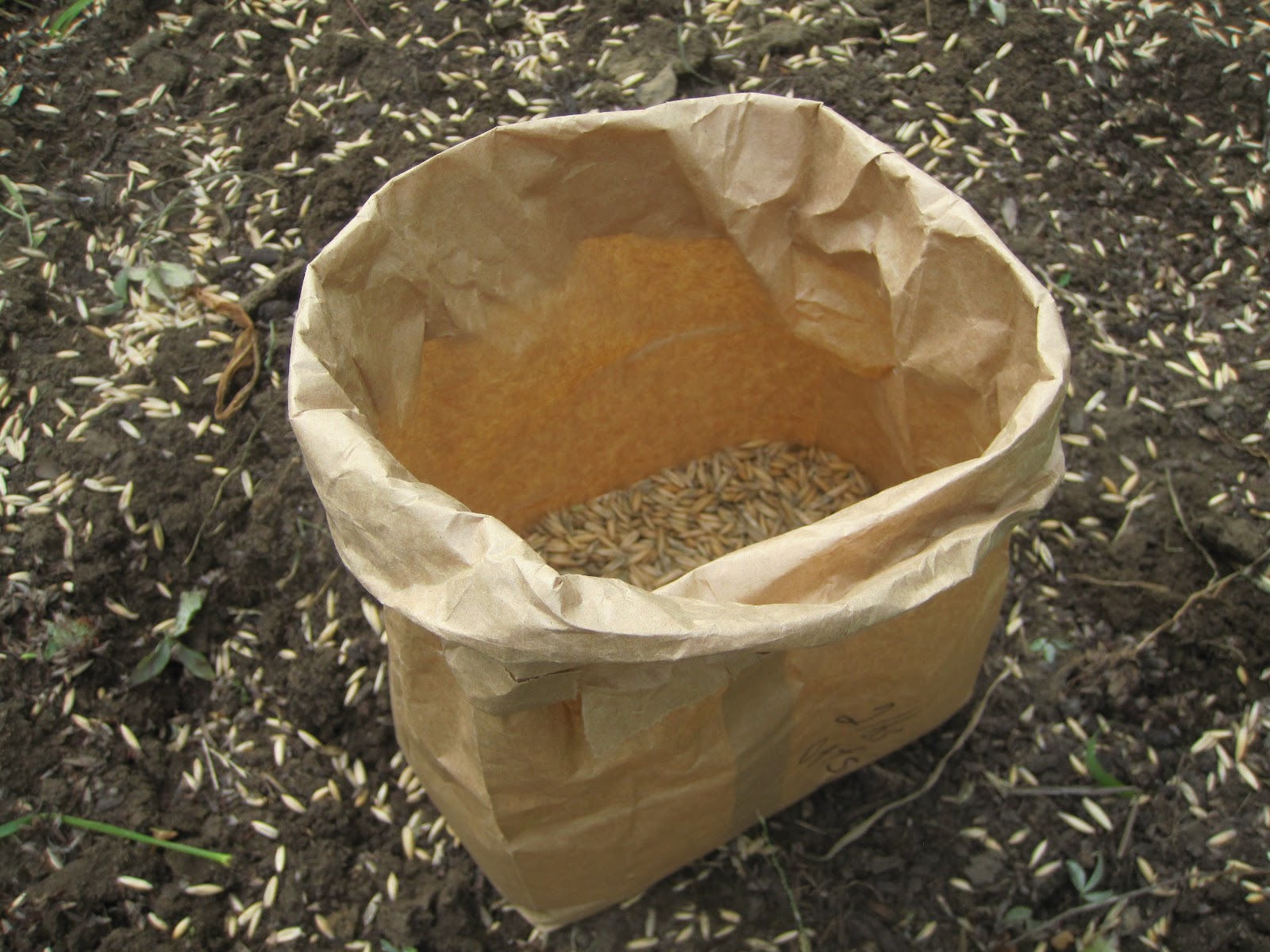
These are my oats. They're not wild. I bought them at the Hadley Garden Center. I'm squinting at the bag in the photo now, and it looks like the oats were $2.49 per pound. At that price, it's very likely that they're not organic oats, but organic-or-not was not on my mind while I sowed them. I was thinking about the old saying, sowing one's wild oats. I was throwing oats onto the soil by the handful. There were so many of them! I was throwing hundreds of oats at a time, a handful of them every few seconds. The numbers were staggering. I thought, God, what if I played around this much? I would surpass Wilt Chamberlin in no time! Wilt, if you don't know, claimed that he sowed more than 20,000 handfuls of oats in his lifetime, but I could have easily slam-dunked his record in an afternoon at the rate I was sowing them. It was marvelous to think about how prolific nature is. The sparrows, as I knew would happen, already got the memo about the oats, and as I type this they are hunting and pecking around for loose grains in the dirt. That is how nature works, my friends.

Even though I added some straw to conceal the oats, the birds are still on point. You can't fool a hungry bird with some straw, nor can you fool a hungry gardener by dangling a plastic radish in front of him. If I keep typing out this blog, I am going to become drunk. I am just about two afternoon beers deep and I need some dinner pronto. I would like to talk about trials and tribulations of dating, but I am too hungry for that, and I am much better finding metaphors for life in the dirt. I need to eat something. Food is very important.
The last couple of days, Ed's been snooping around my corn patch. I went outside the other morning, and there he was, at the edge of the patch, bad hip and all, leaning into the patch, hand on his hip, eyeballing my ripening ears of sweet corn. He wants "two or three" ears. He's repeated this several times in the last two days. If you don't know how to tell if your sweet corn is ripe, watch for your experienced old neighbor to come snooping around your corn. That'll be one sure indicator. Old guys who grew up around farms and farmers tend to know when a sweet thing is ripe. Here are the ears I cut today. I just kind of chucked them over the railing of the porch, and they made a pleasing and light thud thud thud when they landed.

About eighty-some days ago I popped some hard corn kernels into the ground, and now, this very afternoon, I'm sitting in the shade of my side porch, sipping on a beer after harvesting, shucking, blanching, shocking, cutting, milking and bagging my first ever ears of ripe, sweet corn—Peaches and Cream variety for those of you who are interested. There are many more ears still on the plants, but today I put up three bags. And that's organic corn, mind you. It would cost about $4 per bag at the co-op. Here's the cost break-out, roughly:
Seeds..............................................................................................$3.00
Organic fertilizer................................................................................$3.00
Ice (for shocking)................................................................................$2.00
Water (for ice water)......................................................................negligible
Natural gas (for boiling)....................................................slightly less negligible
Freezer bags.....................................................................about 15 cents/bag
That cost break-out obviously doesn't include my time, nor does it include the rent I pay, but just as equally one cannot account for personal satisfaction, nor put a price tag on quality of life, nor is it so easy to measure the untold amount of happiness countless neighbors have received merely from strolling by my front yard and watching my corn plants progress from seedlings to maturity. If we're going to do a cost accounting and be very profit-centric Americans, we'd also do well to take into account those things that frequently do not show up on balance sheets and metrics: joy, pleasure, happiness, neighborliness, personal satisfaction, taste, and, if I may be so bold, LOVE. Money might make the world go round, but LOVE keeps it from being a dizzy and pointless affair. Enough of my babbling. The soap box beneath me is starting to wobble anyhow.

I suppose I forgot to include one cheap-o plastic garbage bag that I could have done without. I cut the bag along one side and the bottom seam to line my sink, mainly to keep my precious sweet corn free from sink nastiness, a pure and superstitious move my rational brain knew was completely unnecessary. I mean, it's funny that I trusted a plastic garbage bag over my own kitchen sink. Anyhow, we live in a world of plastic, and plastic does have its uses. This sweet corn will ultimately sleep, swaddled in a zip-lock blanket, for who knows how long, until the winter afternoon when I decide that I want corn chowder. Oh, and by the way, after you boil your ears of corn for about four minutes, you want to shock them (to stop them cooking) in ice water for another four minutes. Then, when they are cool, you strip the cobs of their kernels, from tip to bottom, with easy downward strokes from your sharpest knife.

Eight-some unsure and unsteady American dollars divided by three little bags of corn rings each of these babies in at $2.81 dollars a bag, a per-bag cost will continue to drop as I harvest, process, eat and share the ears that are still remaining on the plants. I am certainly not going to become rich in this manner. We all know that. Nobody ever said, That Jono, he's bound for riches, but this is obviously more about stuffing my freezer than it is about stuffing my bank account. Speaking of bank accounts, I'm heading back to Stan Crawford's farm in Dixon, New Mexico once again this fall, and me and Oil Changes are planning some interesting fund-raising events that might include a Route 47 dance party and a fresh tomato juice, Bloody March brunch. It will be great to have you along again as I go.
Sometimes I think I only plant beans to make work for myself, which isn't an entirely abnormal for a human thing for a human to do. If there's no problem around, we humans will make one. For instance, the computer. My computer keeps jumping onto a nearby, unlocked network, which is driving me nuts. Back in the 90s I loved solving computer problems, so much so in fact, that I would frequently fake sick so that I could stay home from school and monkey about on our home computer. Now, of course, I am not into computers. I prefer simpler tools like knives. I can understand a knife.

My green beans are coming in like crazy now, which means that I'm somewhat crazy now, too. When you participate in a season for the purpose of canning green beans, the season forces you onto its schedule, which exhilarates some and infuriates others. I mostly enjoy it. Sitting on my porch in the shade, trimming the ends of my green beans, to me that's when life is sweet. I decided to let these green bean ends sit on the porch table so that I could watch them dry out. A friend came over the other night, and after I talked about them for ten minutes, she asked me what I would do with them, to which I responded, "Put them in a jar." Here they are, only moments after being cut.

I spend a lot of time during the peak of summer preserving vegetables, either by canning them, freezing them, or fermenting them in crocks, and at the same time I save seeds by drying them in the sun. I am not saving these bean ends for any practical purpose, but watching them dry out is purpose enough. In high school my friends would tease me by saying, "Simple pleasures," as if that were some kind of insult, which I could never really understand, but I suppose watching bean ends dry out is a simple pleasure. I photographed them over the course of three days. Here they are on day two.

The more that I look at this picture, the more I realize that there is nothing so simple about this. I mean, if you can't appreciate the way the cellular structure of a green bean end is transformed by the sun, what do you appreciate? If one were so inclined, he could sit down and write a long document about all the observable changes. I'm not all that inclined to do that. You can look at the pictures yourself. I do want to pipe up a bit and make a remark about the pinks. Look at those pinks! The Paas Easter egg coloring company would die to cram those pinks into a tablet.

On the third day the beans were completely dry. I can now safely put them into a jar and lid it, without running the risk of the beans rotting from miniscule bits of transpired moisture which would cause a greenhouse-like atmosphere to form inside the jar, thus re-hydrating the beans enough to potentially jeopardize their perfect, dry states. This is the secret to drying things. Do not put them into enclosed containers until they are 100% dry. Where there is water, there will be microorganisms.
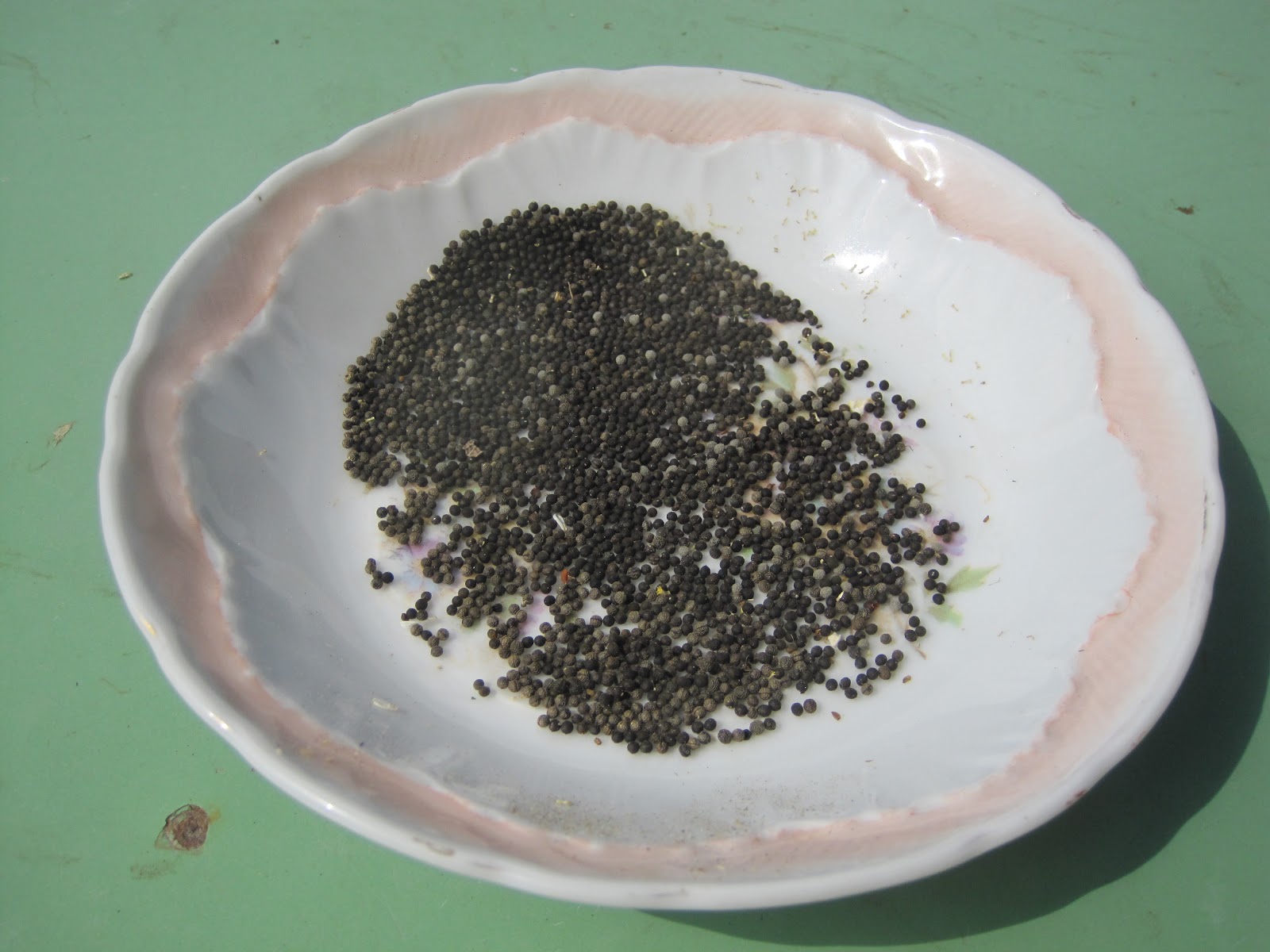
When you spend so much time alone, you tend to think. This morning I'm thinking that the fourth of July has no meaning anymore. I'm thinking that there needs to be a new fourth of July, one that celebrates our independence from the tyranny of trans-national corporations who have no actual loyalty to this country and yet who maintain enormous sway over its politics and the lives of the people who live complicitly in it. I'm one of those people, and over the years, fourth after fourth after fourth, I've become much more comfortable with the fact that I am small, small but not powerless. One man cannot change the world by saving a couple poppy seeds, but he can live closer to his principles if he does. A couple lines from Walden should suffice: "Most of the stone a nation hammers goes toward its tomb only. It buries itself alive. As for the Pyramids, there is nothing to wonder at in them so much as the fact that so many men could be found degraded enough to spend their lives constructing a tomb for some ambitious booby, whom it would have been wiser and manlier to have drowned in the Nile, and then given his body up to the dogs." Amen. Now let's talk about California poppies. This is what one seed pod looks like before it explodes.

This particular pod did not explode as forcefully as some of them do, so you will have to trust me when I tell you that the architecture of a California poppy seed pod is such that the pod, when ripe, explodes with a violent cleaving whose force is enough to eject the seeds. Basically, the pod pops open and chucks its babes abroad. Put another way, the green pod is a kind of loaded spring, like a rat trap whose trigger is not a rat but life itself. When the plant starts to die back, the life force that held the pods closed weakens, and the stored potential energy inherent in the design of the pod is unleashed. The seeds shoot everywhere, and this actually presents a problem for the seed collector. It's best to let the pods open by their own action, rather than pry them open forcibly, but with this comes the inevitable consequence that the plant will shoot many of its seeds beyond your grasp, which is the plant's wont to do. The solution is easy: you just put the unexploded pods in your grandmother's old pie plate, and you accept some inevitable losses.

This is not the first time that I've written about seed dispersal methods. Of the one-hundred-and-one things to think and write about plants, seed dispersal methods is among my favorites. It fascinates me because it's so pregnant with metaphor. In the past I've compared plant seed dispersal to human beings packing their kids off to college, which is to say that I've only thought about where a plant sends its offspring, not about the force with which it sends them. Not all plants use force to disperse their offspring, or at least not all plants use such explosive force as the California poppy—some use wind, some use animals, some use obsessive humans like me. Whatever the case may be, collecting seeds this morning I watched one explode by its own volition, and I could not help but think about an expecting human mother and the muscle she is equipped with to push out her baby. That baby doesn't just slip out. California poppy seeds do not slip out languidly either. There is always some mechanism to birth a new thing, and sometimes force is involved. Think about that when you watch the fireworks tonight. What force pushed those sulphuric flowers into the air?

The gardens I love most are those in which there is room for the weeds. The way plants jockey for position in the garden moves me. There is only so much real estate, and each plant competes for space. They compete with each other, and they compete with me. I have a strong will, but so do the plants. We share a common will toward life. Perhaps they don't wake up on some mornings and think, I'm not so sure I want to live this life, but even so we are fundamentally the same: we have come to life, and following through on life is what we do. Obviously plants cannot be self-destructive—"self-destructive" is a term that we humans reserve for ourselves, a notion that we use to set ourselves apart from the rest of life—but I can never approach that sort of idea without questioning it, which is to say that I'm not sure what self-destructive really means this morning. One thing is sure: I am not a plant.

Look at that will! Lemme drop some botanical knowledge and give you the back story. BOTANICAL KNOWLEDGE: chamomile seeds are so light; they're almost like flour. The wind, who is the nemesis of reading the newspaper and rolling cigarettes outdoors, is the chaperon of the chamomile. When the seed heads mature and bust open, the wind disperses the seeds. It blows them around the way it blows dust around. And so it is that this chamomile plant arrived in its current location. Last year I had a bunch of chamomile plants in one continuous location in my garden, which is to say in one spot. This year there are chamomile plants all over my garden, and some of them have even ventured beyond the garden to take up residence in that most difficult piece of real estate, the thin layer of dirt alongside the road. You can see that it's a stressful but not inhospitable place to live. The plant's stems are red, and red, in this case, means I'm stressed. Stressed but making it even so.

If you pay attention to where volunteers show up in your garden, or where they show up period, you can learn a lot about life, most of which I am not inclined to talk about this morning. This little chamomile bugger is also very near the curb, and he is bound for a premature death. I mean, there's no way he's gonna make it. He has the lawn mower to contend with, and the grass that surrounds him will bounce back much more readily from a mowing. If I didn't mow the parkway at all this season—and I'm very tempted not to mow this year—that chamomile plant might manage to produce a few seeds. It's trying to produce them now. Look at it struggle with its dinky yellow helmet! Bless you, tiny warrior.

Chamomile actually likes tough locations, which is to say that it is cut out to live in the tough locations where many other plants cannot, but it does live much more successfully if it finds itself with a nice piece of real estate that is free of too much competition. This is why cities are not fruitful places. We can inhabit them, and boy do we ever inhabit them, but we don't find an abundance of orchards among all that concrete. A tree does grow in Brooklyn, as the story goes, and it's a nice tree, apples or no apples.
So, yeah. Hopefully I have complicated your thinking about the difference between humans and plants this morning. I gotta fetch my breakfast now.
New York is good, but home is amazing. I woke up on a mattress on a floor this morning in a part of Brooklyn whose name I cannot remember. I had been at birthday party in another part of Brooklyn whose name I cannot remember, and before that I was in Manhattan, on the lower East side, and the blossoming pear trees looked amazing for a moment as their petals fell through the mist. Earlier in the day I was reading haiku in an apartment in still another part of Brooklyn, Williamsburg, and the pear blossoms seemed perfect in the cold.

But there are no pear blossoms on the Williamsburg bridge. Not unless you carry them across yourself. Which I am sure someone has done before. I like to think about that someone, and to whom they are taking those blossoms. And why. Why are you taking those blossoms across the bridge and where are you going? There are a lot of people in New York city, but there is only steel and sky in this picture. Steel and sky and tremendous shadows. To cross a pink and blue bridge on foot is amazing, but it is not a garden. To go out of town to spend time with good company and then to go home again is sweet. I am always happy to see my garden after a spell away from it. Sometimes I return with a new set of fond memories, and sometimes I don't. This time I did.

This life of writing makes my path cross the paths of a lot of great people. Naturally, there are great people in every field—no, I take that back—there are some professions that are bound to attract sordid types, but poetry is generally not one of them. This is something worth remembering. I found my garden greener and taller when I came home. Four days can seem like a lot more than four days for a busy human, but plants I think have no sense of time. They only grow and die back in response to the weather and the season. I did a lot of responding to the weather in New York. When it rained, I moved under the awning. When I got cold, I pulled my hood over my head and wondered about my chives. A couple purple flower buds formed while I was away.

The alfalfa shot up a lot, too, while I was away. When you are away, your life is in two places. Your life is wherever you are and the home where you are not. We could naturally extend this idea and say that our lives are in all the places where the people we love and who love us think about us. My life, then, is here by this alfalfa, but also in Brooklyn and Chicago, California and New Mexico. The logical conclusion is that all of us are in a lot of places. This, perhaps, is why home is so important and such a comfort to return to. One or two Johnny Jump-Ups also started flowering while I was away.
This typewriter has been sitting on a chair, this chair, in my dining room for about three weeks now. It's not in the way, and the chair is a spare chair, so I don't have too much motivation to move it. I do stand on it when I want to adjust the track lighting, but since the typewriter has been on the chair, I haven't found much need to adjust the track lighting. I'm not totally depressed—I still bathe and socialize and cook—I'm just somewhat bored of things. My room, for instance: waking up in there (here) is old hat. It's the same old room. Today I kidded around with Guy that I should paint it baby blue, like a paint job would do the trick. That's what people in movies do. They paint their terrible rooms because there is nothing else they can change in their despondent lives. So my room stays the color it is, and the typewriter stays on the chair.

I should say that the typewriter does not work. I brought it in for a service estimate, and the estimate was reasonable enough, but I couldn't justify spending $150 to get it serviced at the time. I mean, I don't need a functional typewriter. What would I do with it? Write more letters? All I do these days is write letters and watch movies. When I found a depressing movie that is all about writing letters, I fell in love. News From Home is one of Chantal Akerman's films that she made before she made her most famous film, Jeanne Dielmann, 23, Quai du Commerce, 1080 Bruxelles. Jean Dielmann is a single mother who turns tricks for extra money. That's what that movie is about.

I'm not sure what News From Home is about. I could be reductive like I was with Jeanne Dielmann and say that it's about letters, but I wouldn't want to reduce News From Home because I love it so much and because it is already so reduced. I think it's about being depressed and far away from home and family. The premise of the film is heartbreaking: the narrator of the film (who is never pictured) stands behind the camera and watches life pass by in New York city. The camera hardly ever moves. It doesn't track action or ever flinch. On top of the still shots, letters from the narrator's mother (who lives in Belgium) are read by someone—perhaps the mother, perhaps the narrator, we don't know. In the shot above, we get to watch the Cadillac maneuver around the camera. It's awesome. So are lentils.

I made a huge pile of lentils the other day because I was in my pantry and I looked at my jar of lentils, and I said to myself, Fuck, I haven't made lentils in so long, so I made some lentils. A ton of them. If you read the last post about tearing out the rose bushes, you already know that I turned these same lentils into soup. Something about lentils seems appropriate for how I am feeling lately. Maybe it's because these lentils are brown and they look totally unappetizing? Am I feeling brown and unappetizing? Is life brown and unappetizing? What's the answer? Maybe it's that lentils are dull and boring, a dull and boring food, but that sounds like slander. Lentils aren't necessarily dull and boring, although some foods are amazing foods for being dull and boring. It's their dullness and their blandness that we love about them. Who wants to eat flashy shit all the time? Lentils don't flash. Lentils are stable and I like that. Lentils will be there when not much else is. Lentils, food for the sad.

Last May I spent about five dollars on three packets of beans. It took me about 20 minutes to plant them, several hours to shell them once they were mature, and who knows how many hours to weed around them when the plants were seedlings. The yield? About two pounds of beans, black and anasazi. If organic dried beans command about $2.00 per pound at the supermarkets, and if "boutique" dried beans cost as much as $5.00 per pound at farmers markets, I might be sitting on as much as $10.00 worth of dried beans. Subtract the five bucks for seed, and you're looking at a whopping $5.00 profit. This is no way to get rich. So why do it?

Well, if you don't like the labor, you shouldn't do it. Most home gardeners work a plot of land that is too small for low value crops (like dried beans) to compensate their investment of time and, more importantly, the space the beans take up. The truth is that, from a dollars and cents perspective, there is absolutely no reason to plant and harvest your own shelling beans. I'm gonna dub them "pantry beans" right now, because mine are currently in my pantry, and they look fantastic in their jars. Does that make them more valuable? It does to me. I don't play the stock markets, and I don't have life insurance. I don't have dental insurance, but I don't drink Coke. Are we getting somewhere now?

I might be playing a fool's game, running this miniature farm in my front yard. Spending as much time as I do to produce food (and luxury goods like flowers). The market can easily undercut me. Time is money, but I still invest my time in the "profitless" enterprise of gardening and self-sufficiency. Why? The answers are many. Here are three: (1) The high quality food I get cannot be obtained at any grocery store for any price; the goods are simply not available. Not even the most high-brow posh brands can compete on quality. (2) The work gratifies me. When I tend my garden, I feel good. My garden keeps me interested in living this life. For someone prone to depression, putting a price tag on time spent in the garden is an impossible and foolish enterprise. Finally, number (3): beans are political. Anymore, I don't rant about the gross injustices of this world, but I do plant beans. I prioritize my time so that I can do what I intend to do, and I intend to run a mini farm in my front yard. Penny for penny, the massive food corporations can beat the pants off me. They can sell me a pound of dried beans for peanuts, but at what cost and to whom? If I replant a handful of the beans I harvested this year, next year I will know the entire arc of the beans I harvest. I will know the entire arc of their existence. The beans that tumble out of the bluk bins and into my baggie at the grocery store...I don' t know squat about them. I don't know who picked them, who shipped them, who hauled the heavy sacks of them on and off a bunch of trucks I don't know anything about. The point is that the food system is a system like any other, but also that you can opt out of it with each bean you shell.
Can I opt out completely? Probably not. Would I even want that? Is that even a good idea? Also probably not. But is it important, both actually and symbollically, to take the power back? You bet it is. That's the real value, and it's a value that's hard plug into a spreadsheet. And it must be this way. In a world driven by dollars and cents, by profit, the meaning of "value" is flattened out, it becomes, to use the term coined by Herbert Marcuse, 1 dimensional. Value has only one meaning, and that meaning is $$$. This is precisely what the powers that be want. They want their value to be more valuable than your value. They don't even want you to have your own notion of value. This why I plant beans: I don't like those guys; I think their value stinks.
Yesterday's 5.8, Richter scale magnitude earthquake that wobbled a couple chandeliers in D.C. and made pin-flags shimmy up and down East coast country clubs probably meant zilch to the bees and other flying objects that buzz about the "activity centre" in my front yard garden. More and more, my garden is less about the food I take from it and more about the food and employment it gives to the native insect populations. Rather, I should say it's more and more about pleasure I take from watching the bugs, most of which are very cooperative (unlike some baristas I know) when I stoop down to snap a photo with my 12.1 megapixel PowerShot.

This is Henrietta. She's feeding on a zinnia. If you look closely, you can actually see her proboscis dipping into one of the flowers. One of the flowers? Huh? Well, I did not intend to launch into flower botany 101 this morning, but here goes: zinnias are compound flowers; compound flowers are flowers that appear to be one flower but upon closer inspection are actually a bunch of flowers. So, to be technically accurate, the actual flowers in this photo are those little yellow, trumpet-shaped buggers in the middle. Hence, Henrietta is dunkin' her tongue into one of them. I should add that Henrietta stands alone among the butterflies that frequent my garden. She sat still for numerous shots; most butterflies have ants in their pants. They don't sit still.

The honey bees, on the other hand, don't give a damn about me. I've poked them before with the tip of my lens. They just go about their business, a business that is just as serious as any I know. Don't tell a roofer that a bee works harder than he does, but the next time you see a roofer chucking an old shingle onto a garden, think it. One time I told a dude in the construction biz that the raccoon we were watching pick through a garbage can was "earning a living." This did not go over well. "Earning a living" was exclusively reserved for people, preferably people who sit in cubicles, pay cellphone bills, and pump gas. (Oh, gas...I'd nearly forgotten that we're racing toward the end of this Oilchanges X-Country Road and Farm Fun(d) Drive month. Click the gas can.) Anyway, we're all earning our living, even the plants.

This wild member of the onion family opened shop and immediately attracted customers. In this case, just this one honey bee, George. On both ends of the time continuum that surrounds this photo, George can be found extracting onion nectar from each of the open flowers. What's the price of that nectar? The onion shopkeeper told George that he could have the nectar if he would get some pollen on his body and move it from flower to flower. George agreed heartily. He carries his wallet on his fuzz. I have one last point I want to make about the activity centre.

I love a green lawn as much as the next guy, and if I didn't have a lawn to mow, by my calculation I'd be 14% less happy, so don't start thinking I'm a lawn hater, because I'm not. I'm a lawn lover. Still, though, lawns do come at the great expense of possible activity centres everywhere. My neighbor's house is exactly the same as mine: same layout, same lot size, same amount of front yard. His, however, is crabgrass. Mine's garden. His front yard is bug-free. Mine's bug mania. Mine's activity centre. His is go away. If your heart doesn't bleed for bugs, you might appreciate the human consequence of a crabgrass exterior. I have all sorts of neighbors that stop by my porch and shoot the breeze with me. I give them dill and flowers. They give me chicken manure and eggs and bottles of craft ale on my birthday. I don't know what my neighbor's yard and porch attract. A lawn mower, junk mail and bills. We share that base-line existence. I just personally think it's important to encourage a little community, from the bottom of the food chain up, by planting some flowers and letting some wild plants grow. The rewards are many and nice. According to the poet, A.C., I am my garden's "animal." I work for it, and it works for me.